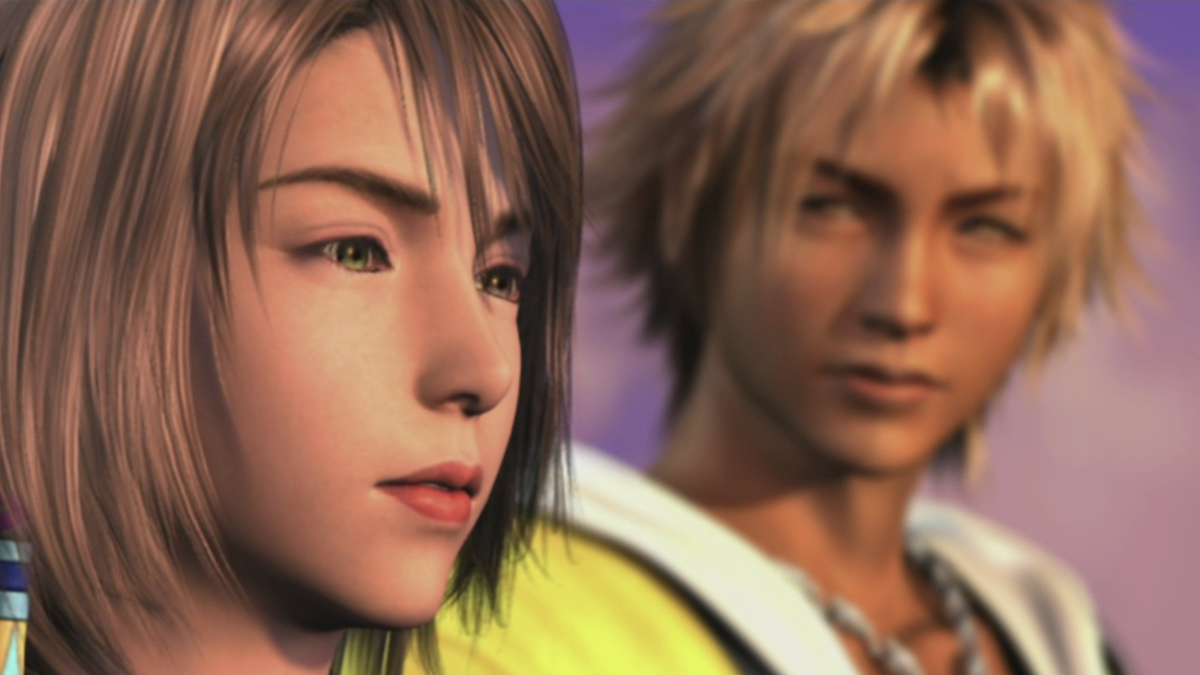
Around the turn of the millennium, straight edge hardcore singer Bill Muir was asked by Japanese game developer Square (now known as Square Enix) to lend his vocals to a song for its upcoming RPG, Final Fantasy X. It seemed like just another recording session. Instead, it became the opening track to one of the most beloved games in the series. Twenty-five years later, “Otherworld” remains one of the most iconic video game openings ever made.
At first, Final Fantasy X lulls players into a familiar rhythm. Gentle music plays over the opening menus, evoking the orchestral soundscapes longtime fans had come to expect from the series. Then, just minutes into the game, Muir’s ferocious vocals rip through the silence. As Tidus awakens and flashes back to his former life as a blitzball star in Zanarkand, “Otherworld” explodes onto the soundtrack, replacing tranquility with pounding guitars and raw aggression. It’s a startling introduction that immediately announces Final Fantasy X isn’t interested in playing by the series’ established rules.
Muir, who was in his late twenties at the time, was living in Tokyo and performing with his band, xtillidiex (pronounced “Till I Die”), when he was asked to work on the song. A few months after the game’s July 19, 2001, release in Japan, Muir got a taste of how much people loved the track.
“I remember being at a show, a later show for my band xtillidiex, as we were wrapping up and I was going to be leaving Japan, somebody having that song on as a ringtone,” Muir told Mashable over a video call from Los Angeles. “And I remember slowly turning and looking at that and being like, “Oh my goodness! Like, this [game] is a pretty big thing.”
Most people who played Final Fantasy X shortly after its release were introduced to the song before social media and Shazam, which led to several rumors about its origins. Many people thought the song was by the heavy metal band Rammstein because of what Reddit users describe as an erroneous artist credit on the peer-to-peer file-sharing program Limewire — long before the days of legal music streaming, millennials turned to more illegal measures.
Others thought it was by The Black Mages, a rock band in which Final Fantasy composer Nobuo Uematsu was a member from 2002 to 2010. Either way, people were hooked, and they’re still talking about it a quarter of a century later.
This Tweet is currently unavailable. It might be loading or has been removed.
This Tweet is currently unavailable. It might be loading or has been removed.
This Tweet is currently unavailable. It might be loading or has been removed.
As of July 2026, “Otherworld” has close to 9 million streams on Spotify. A remastered version of the opening sequence, released in 2014, has 1.5 million views on YouTube. The song still appears on legendary video game music lists, and people continue to post on social media about it being one of the best video game openings.
In honor of the game’s 25th anniversary, Square Enix is also releasing a remastered version of Final Fantasy X and its sequel X-2 for the Nintendo Switch on July 23.
The game follows Tidus after he appears to be transported 1,000 years into the future. During the “Otherworld” opening sequence, we see Tidus meeting a character named Auron (who, like his name suggests, emanates aura) and having flashbacks of Zanarkand being destroyed by a colossal, monstrous force called Sin.
Tidus wakes up in Spira, where Sin is still wreaking havoc and destroying entire cities. He joins Yuna, a summoner who hopes to defeat Sin, and her ragtag group of guardians.

The Zanarkand ruins in Spira.
Credit: Square Enix
While Final Fantasy X is often remembered for its groundbreaking graphics and cinematic cutscenes — few are as iconic as Yuna’s Sending — it also stands out for its willingness to grapple with darker themes. Beneath its fantasy setting lies a story about grief, generational trauma, religious corruption, death, and the search for meaning in the face of inevitable loss. It wasn’t the first Final Fantasy game to tackle those ideas, but it was the first video game I played that made the stakes feel genuinely existential.
That emotional depth resonated with millions of players. According to Square Enix, Final Fantasy X and Final Fantasy X-2 have sold a combined 20 million copies worldwide since their original releases in 2001 and 2003, making them among the best-selling entries in the franchise. Released on the PlayStation 2, Final Fantasy X also marked a major technical leap for the series, introducing fully voiced characters and pushing the console’s graphical capabilities to create a more cinematic experience than fans had ever seen.
I was about nine or 10 years old and still riding the Kingdom Hearts high when I spotted Final Fantasy X at my local GameStop. I recognized Tidus from Kingdom Hearts, where he appears as a supporting character, and decided to give the game a chance. Up until then, my only experience with the series had been Final Fantasy III on the Nintendo DS, a relatively straightforward RPG with a whimsical fantasy world and a mellow, orchestral soundtrack. When I got home, I popped the PlayStation 2 disc into the console, my little brother settled in beside me, and hit start.
Just minutes later, we were frozen in front of the TV. As Tidus awakens in a dazzling CGI cutscene, the opening riffs of “Otherworld” crash through the speakers, replacing the serene music that had greeted us in the menus. My brother and I just stared. In an instant, Final Fantasy X announced itself as something entirely different — not just from the Final Fantasy games I’d played, but from almost every video game I’d experienced.
That sense of bold experimentation extended far beyond the opening cinematic. Final Fantasy X marked the first time longtime series composer Nobuo Uematsu shared scoring duties with other composers, bringing in Masashi Hamauzu and Junya Nakano to help shape the soundtrack. The collaboration resulted in one of the franchise’s most eclectic scores, seamlessly blending orchestral pieces, piano ballads, ambient soundscapes, and hard rock to forge a musical identity unlike any other in the Final Fantasy series.
How an unexpected meeting at a Japanese restaurant led to Muir working with Square Enix
“Otherworld” was composed by Uematsu, who recruited translator and author Alexander O. Smith to write the lyrics, and vocalist Muir to sing the song.
Muir said he first met Smith through a mutual friend in either 1999 or 2000, while he and his bandmates were putting together demo tapes at a restaurant. When Smith said he was interested in hearing some of the band’s music, Muir charged him 200 yen for a demo tape.
“If I had really put together how important this would be in my life, I would have given him the tape. Instead, I charged him for the tape,” said Muir.
Smith obliged and said that he worked for Square Enix and that they might be looking for someone to work on a song. A few months later, Smith emailed Muir, asking him if he wanted to come into the Square Enix office for an interview.
Mashable Trend Report
Muir said he showed up casually in a band tee with either ripped jeans or camo shorts, with his skateboard in hand, which he said was probably inappropriate for the setting. But somehow, that didn’t deter the folks at Square Enix from giving Muir a chance.
“They played me the song, which was nothing like the song as we know it now,” said Muir.
He said that they initially played the song on a keyboard and had asked him if he would be willing to rap on the track, which he turned down.
“I’m good to go for screaming, yelling, and maybe some angry muttering, and growling,” Muir said he told them. “Weirdly, that didn’t turn them off.”
The rest was RPG history. They brought Muir to a full studio in a basement, where Muir met the band and went over the lyrics a couple of times before recording. He said that there wasn’t much direction from Uematsu and the team on how Muir could approach the song, so it was a very hands-off process.
“They knew what I could do at that point, and whatever I was going to do, I was going to do,” said Muir.
Muir added his own touch at the end of “Otherworld,” and if you listen closely, the last few lyrics are a shoutout to his band, xtillidiex: “straight edge/til I die/my lost cause, lost cause, lost cause in this world.”
Rebellions, and the legacy of “Otherworld” and Final Fantasy X
It was the first game in the series to feature full voice acting, a fully 3D-rendered world, and more complex, layered sounds. Since the PlayStation 2 had twice as many audio channels (48) as the PlayStation 1 (24), it could support a wider range of sounds and music, making it the perfect platform for a collaborative soundtrack by composers Uematsu, Masashi Hamauzu, and Junya Nakano.
“Seeing those visuals and the story and the music, it was like nothing else that was on the market at the time,” said The Night Sky Prince, a digital creator who has been making content on Final Fantasy and other Japanese RPG games for over 10 years.
The Night Sky Prince told Mashable that previous Final Fantasy games were associated with a more synth-heavy, orchestral sound, but that the new hardware enabled a more vocal, live-instrumental approach, challenging the preconceived notion of what “video game music” is.
He said that “Otherworld,” in particular, is unique to the Final Fantasy series because of its proximity to metal and rock genres.
“I feel like that genre choice is very interesting, in part because it can kind of represent rebellion, which I feel kind of represents the dynamic of Tidus and Jecht’s relationship quite a lot too,” he said.
In a way, the soundtrack was Uematsu’s form of rebellion, or at least his way of breaking away from the previous ways he composed the Final Fantasy soundtracks. In a 2011 interview with RPGamer, Uematsu joked that Final Fantasy wasn’t him, but “Otherworld” was. He said that since Final Fantasy X was released on the PlayStation 2, he finally had a way to express rock music, which is the foundation of his work.
Combined with Muir’s refusal to rap the lyrics in favor of staying true to his hardcore roots, even if it meant losing the opportunity altogether, “Otherworld” became more than just an opening theme. It challenged expectations of what a video game soundtrack could sound like, especially within the Final Fantasy series. That uncompromising spirit is still part of what keeps drawing fans back to the track.
This Tweet is currently unavailable. It might be loading or has been removed.
This Tweet is currently unavailable. It might be loading or has been removed.
This Tweet is currently unavailable. It might be loading or has been removed.
The Night Sky Prince said it’s one of the songs that he will frequently turn on when he’s at the gym because it’s the “best song to listen to while doing a bench press.”
“To this day, ‘Otherworld’ is the only track in all of music ever made that can get me out of a funk. ‘Go. NOW. If you want it,’ reminds me that I need to get off my ass and make things happen,” said Reddit user rogdesouza in a 2025 thread about the song. “I played this game over 20 years ago on the PS2, and it has stayed with me ever since.”
Digital creator DizzieDee, who is also known for her content on Final Fantasy and JRPGs, posted about the song on X on June 8 of this year. She said that Final Fantasy X had the best opening of all time, and that “Otherworld” still feels rent-free in her head.
This Tweet is currently unavailable. It might be loading or has been removed.
More than two decades later, Final Fantasy X continues to inspire a new generation of players. Fans still post guitar, piano, and drum covers of “Otherworld” across TikTok and YouTube, while creators like Ollie Dreamer continue to argue that Final Fantasy X remains the best game in the franchise.
For YouTuber The Night Sky Prince, the game’s longevity comes down to one thing: replayability.
“People really like the sort of cinematic, story-driven nature of Final Fantasy X. But Final Fantasy X also offered players a lot of customization with the sphere grid, weapon builds, and the combat system was incredibly deep,” he said. “Because of that, even though the game was linear, players still felt a sense of choice, whether illusory or otherwise.”
Its influence can still be felt throughout the series. Final Fantasy XIII expanded on the Sphere Grid’s progression with its Crystarium system and introduced Eidolons that echo X’s iconic god-like Aeons. Final Fantasy XVI, meanwhile, revisits many of the themes that made X so memorable, sending its protagonist on a deeply personal journey against seemingly godlike forces.
Perhaps the most memorable callback, though, comes near the end of Final Fantasy X. “Otherworld” returns during the climactic battle against Braska’s Final Aeon, who is revealed to be Tidus’ father, Jecht. By then, players also know that Jecht was Sin, the monstrous force introduced during the game’s opening cinematic. The song that first welcomed players into Spira comes back one last time, transforming what began as a shocking introduction into a powerful full-circle moment about grief, sacrifice, and breaking cycles of violence.
Today, Muir is still forging his own path. Outside of music, he works as a registered nurse caring for veterans and has built an online following as “Sergeant Vegan,” where he shares content on nutrition, fitness, and animal and human rights advocacy. He’s also writing a memoir about his time living in Tokyo and touring with his band, and hopes to one day perform “Otherworld” for Final Fantasy fans.
Looking back, though, he’s simply grateful to have played a small part in something that continues to resonate with players 25 years later.
“When that song kicked in, I remember just being like, ‘Oh my God, this is amazing,'” Muir said. “Just the feeling that I’ve accomplished something… to be a part of something that big, it just feels really, really good.”
Fans can pre-download and purchase a digital version of the remastered Final Fantasy X/X-2 on the Nintendo website.