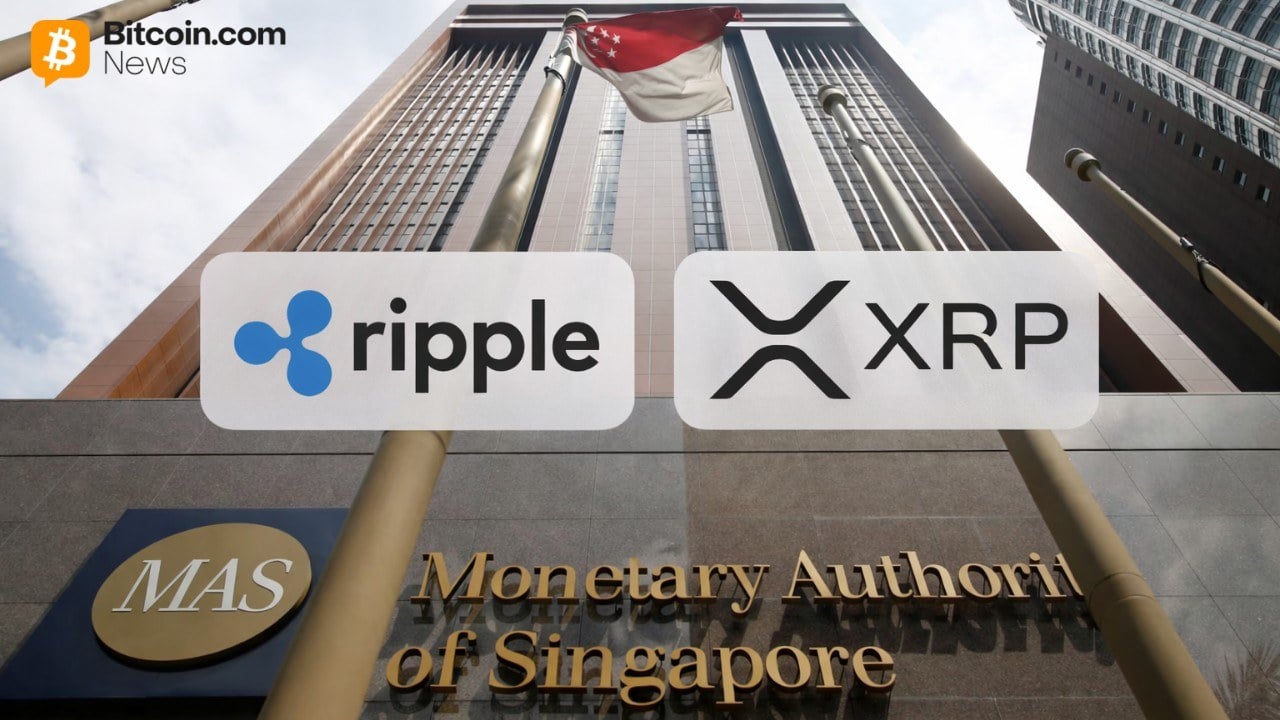
Ripple Joins Singapore Central Bank’s Effort to Drive Tokenized Settlement Systems
Efforts to modernize cross-border settlement systems are accelerating as Ripple announced on March 25 that it has joined the Monetary Authority of Singapore (MAS) BLOOM initiative, incorporating XRP Ledger (XRPL) infrastructure and Ripple USD (RLUSD) stablecoin into programmable settlement models. The collaboration centers on tokenized bank liabilities and regulated stablecoins for conditional payment execution.
Participation involves a pilot with supply chain finance firm Unloq, focusing on trade settlement execution through integrated workflows and conditional payment triggers. Ripple explained:
“The solution leverages Ripple’s institutional-grade infrastructure, the XRP Ledger (XRPL), and Ripple USD (RLUSD) – a trusted, enterprise-grade stablecoin, designed for enterprise use cases.”
Fiona Murray, Managing Director, Asia Pacific at Ripple, said: “Singapore continues to take a leading role globally in providing the regulatory clarity necessary for the digital asset space to thrive.”
Singapore’s central bank detailed BLOOM in October 2025 as a continuation of Project Orchid, which explored a digital Singapore dollar and its supporting infrastructure. The initiative targets expanded use of tokenized commercial bank money and compliant stablecoins across G10 and Asian currencies, spanning domestic and cross-border payments, trade finance, corporate treasury, and agentic transactions.
Programmable Payments and Blockchain Infrastructure Expand Reach
Through the program, MAS coordinates industry efforts across distribution and clearing of settlement assets, standardized compliance automation, and AI-driven payment execution within predefined parameters. Initial participants include Anchorage Digital, Ant International, Circle, Coinbase, DBS, J.P. Morgan, Kasikorn Bank, OCBC, Partior, Schroders, Standard Chartered, Straitsx, Stripe, Temasek, UOB, and Xweave, alongside entities exploring public blockchain-based trials.
Unloq’s SC+ platform underpins the framework by combining trade obligations, settlement logic, and financing processes into a unified execution layer operating on blockchain infrastructure. The system automates payment release once contractual conditions are met while maintaining interoperability with existing financial processes. Murray noted:
“Built on the XRP Ledger, SC+ solution, Unloq’s smart-contract-driven trade finance platform uses RLUSD to automatically trigger payments the moment the shipment is verified.”
“This partnership combines Unloq’s supply chain expertise with Ripple’s secure technology to make global trade faster and more transparent,” the Ripple executive opined.
Collaboration with Singapore’s central bank initiative positions the pilot within a regulated environment intended to test scalable infrastructure for future financial networks. Letitia Chau, President and Chief Risk Officer of Unloq, stressed: “BLOOM represents an important step toward modernising trade finance infrastructure in a controlled and regulated environment.”
FAQ 🧭
- Why does Ripple joining BLOOM matter for investors?
It signals deeper institutional adoption of XRPL and RLUSD in regulated financial systems. - What is BLOOM aiming to achieve in global finance?
It seeks to enable programmable, tokenized settlement across cross-border and domestic markets. - How does RLUSD fit into the initiative?
RLUSD acts as a compliant stablecoin powering automated settlement and trade finance execution. - What is the significance of MAS involvement?
MAS provides regulatory oversight that could accelerate scalable blockchain adoption by major institutions.