Key Takeaways
- Vitalik Buterin flagged ‘relay dependence’ on X as a fragility concern for Ethereum’s smart wallet users.
- FOCIL and EIP-8141 are targeted for the Hegota upgrade in late 2026 to rebuild the public mempool.
- EIP-7701 enables native account abstraction for Ethereum wallets, expected with the Hegota fork.
The Problem With Relays
Smart contract wallets (i.e. crypto accounts controlled by programmable code instead of a standard private key) are becoming increasingly prominent across the Ethereum landscape because they enable multi-signature security, social recovery, and gas sponsorship. Privacy protocols, which obscure transaction details from public view, face a similar constraint because, much like smart contract wallets, they currently depend on third-party relay services to get transactions included onchain.
Buterin has described this relay dependency as a source of vulnerability and fragility, since if a relay goes offline or if a relay operator refuses to process a specific transaction, the end user has no alternative path to inclusion.
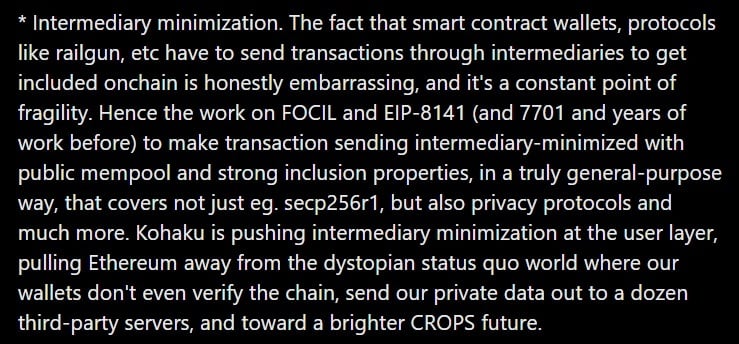
These centralized chokepoints run counter to Ethereum’s foundational principle of censorship resistance, one of the two priorities Buterin has named as central to the Ethereum Foundation’s narrowed technical mission going forward.
FOCIL and EIP-8141 Aim to Remove the Relay Bottleneck
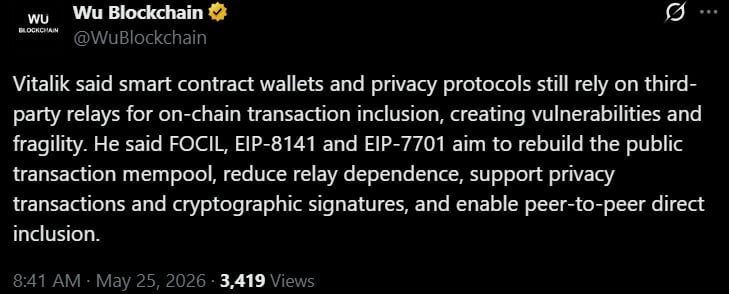
The solution Buterin outlined involves two Ethereum Improvement Proposals (EIPs), the standard mechanism through which protocol changes are specified and debated, working alongside a new inclusion mechanism called FOCIL (Fork-choice Enforced Inclusion List).
FOCIL was officially scheduled for inclusion in the upcoming Hegota upgrade targeting late 2026, introducing a mechanism that randomly selects validators to act as transaction “includers” for each block slot.
That randomness makes it structurally difficult for any actor to censor a transaction by simply refusing to relay it, because no single party controls which validator handles inclusion. The design targets a one-to-two slot transaction inclusion guarantee, meaning valid transactions should find their way into the blockchain within two block intervals.
- EIP-7701 introduces native account abstraction, a change that would give every Ethereum wallet the programmability currently reserved for smart contract accounts.
- EIP-8141 builds directly on EIP-7701 and further extends account abstraction, enabling features such as quantum-resistant signatures, key rotation, and gas sponsorship at the base protocol level.
Under the combined FOCIL and EIP-8141 design, a smart contract wallet would submit transactions directly to the public memory pool (commonly referred to as the mempool), where a randomly selected FOCIL includer would pick them up. No wrappers. No intermediary broadcasters. No relay required at any stage.
Looking ahead, Buterin has stated that privacy and censorship resistance will be two technical priorities for the Ethereum Foundation, with Bitcoin.com News having reported on those strategic shifts last week.
The Hegota upgrade is expected to represent one of the most high-profile consensus-layer changes in Ethereum’s nearly decade-old history, especially since its transition to a proof-of- stake framework back in 2022.