
Circle, the regulated financial infrastructure company behind USDC, launched cirBTC on Ethereum on June 8, 2026, adding a new 1:1 BTC-backed wrapped Bitcoin token to a market already anchored by WBTC at roughly $8Bn in market capitalization and Coinbase’s cbBTC at approximately $5.9Bn.
Each cirBTC token is backed by native Bitcoin held in segregated, regulated custody and verified in real time through Chainlink Proof of Reserve. That is a meaningful structural claim in a category where custody transparency has not always been the default.
Here is the central tension this article unpacks: wrapped Bitcoin has existed since 2019, yet most crypto holders have never had to think about it. So why does Circle’s entry into this market matter, and does its regulated approach actually change anything for the people who would use it?
cirBTC is live on @ethereum.
Circle helped establish the institutional standard for dollar collateral with USDC.
Now cirBTC brings that same approach to Bitcoin, bringing 1:1 BTC-backed collateral to institutional DeFi markets with neutrality, transparency, and Circle…
— Circle (@circle) June 8, 2026
cirBTC Explained: What ‘Wrapped Bitcoin’ Actually Means
Think of wrapped Bitcoin like a coat-check counter at an exclusive club. You hand over your actual coat – your real Bitcoin – and the attendant gives you a numbered ticket.
That ticket represents your coat inside the venue. You can trade the ticket, use it to get a drink tab, or hand it to someone else. But the coat itself stays safely in the back room, and you can always redeem the ticket to get it back.
That is exactly how tokenized Bitcoin works. Real BTC goes into custody with a regulated entity, in cirBTC’s case, a Circle group company with assets kept explicitly separate from Circle’s corporate holdings. In exchange, an ERC-20 token is issued on Ethereum that represents the BTC at a 1:1 ratio.
The token can then move freely through Ethereum DeFi apps, smart contracts, and lending protocols. When you want your BTC back, you burn the token, and the custodian releases the underlying Bitcoin.
Why does any of this matter? Bitcoin cannot natively run smart contracts or act as collateral inside Ethereum-based lending protocols. Wrapping solves that. It is the bridge that allows Bitcoin’s roughly $1.7 trillion in value to participate in decentralized finance without the underlying asset ever leaving the Bitcoin blockchain.
Chainlink Proof of Reserve is the accountability layer; it continuously verifies on-chain that the number of circulating cirBTC tokens matches the BTC held in custody, so anyone can check the math without relying on a periodic third-party audit.
DISCOVER: Best Meme Coin ICOs to Invest in 2026
Circle’s Institutional Play: Why cirBTC Is Different From WBTC
Circle is not just a crypto startup; it has established USDC as a key player in institutional digital finance and is now applying that compliance to Bitcoin collateral with cirBTC. This new offering aims to set an institutional standard for Bitcoin similar to what USDC achieved for dollar liquidity, emphasizing transparency and regulated custody.
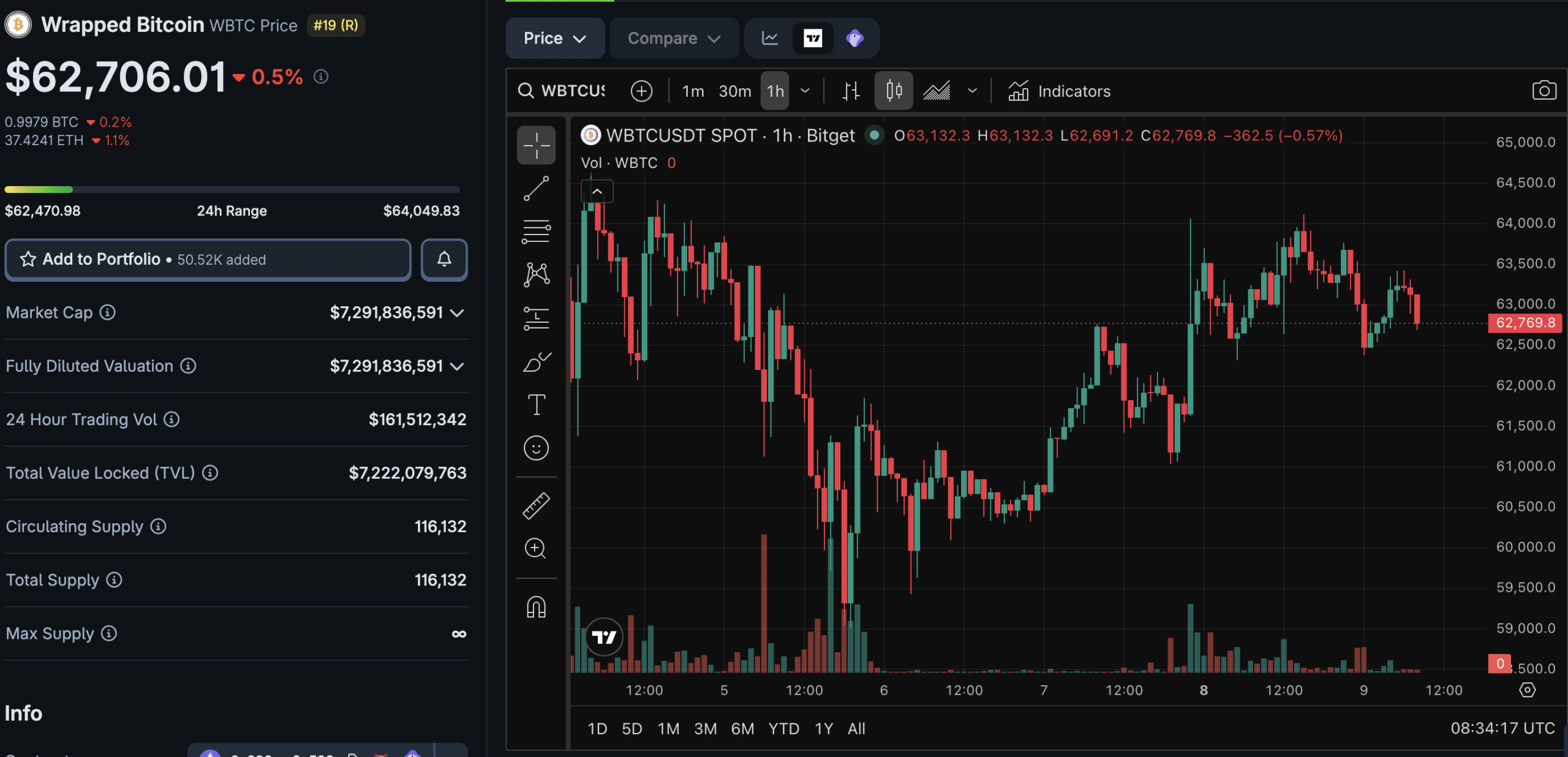
While BitGo’s WBTC, the market leader, has around $8Bn in wrapped Bitcoin, its custodial model has faced scrutiny. Coinbase’s cbBTC, launched in September 2024, reached $5.9Bn in market cap but benefits significantly from Coinbase’s distribution.
cirBTC, however, positions itself with a compliance-focused approach while avoiding competition, appealing to institutions like OTC desks and corporate treasuries that want to leverage Bitcoin as collateral.
Despite its strengths, cirBTC faces challenges, including WBTC’s established liquidity and integrations, as well as cbBTC’s distribution advantages. While Circle’s compliance reputation is strong, it may not be enough to drive DeFi liquidity on its own.
EXCLUSIVE: Earn $10 USDC Via Binance Sign-Up
Rotation, Not Revolution: How cirBTC Fits Into the Wrapped Bitcoin Market
$BTC short-term momentum is still bearish.
If we want a potential trend reversal, the first step is to have a clean break of $64k and $66k.
If $BTC doesn't manage to do that within a few days, the bearish momentum is probably going to continue.
I think in that case we… pic.twitter.com/qRIGnNPRLf
— Quinten | 048.eth (@QuintenFrancois) June 9, 2026
The wrapped Bitcoin market is poised for growth rather than disruption. The rise of corporate Bitcoin treasuries has created demand for efficient collateral deployment in institutional DeFi, a need cirBTC aims to meet.
Bull case: Circle’s compliance and USDC distribution position cirBTC well for institutional adoption, especially with integrations into major lending platforms like Aave and Morpho, creating significant liquidity and a unique cross-collateral workflow. This could lead to a substantial market share within 12 to 18 months.
Base case: cirBTC becomes the go-to wrapped Bitcoin product for compliance-focused institutions, while WBTC maintains dominance due to liquidity; cirBTC may serve as a solid third option as overall institutional demand for Bitcoin collateral rises.
Bear case: Slow integration with DeFi protocols and regulatory challenges could hamper cirBTC’s expansion, leaving it a niche product without the network effects needed to compete with established providers.
The competition is heating up as traditional finance explores tokenized products alongside crypto options, making Circle’s reputation as a regulated issuer increasingly important.
EXPLORE: Best Crypto Presales With Asymmetric Upside in the Current Market
The post Circle Just Launched cirBTC: ‘Wrapped Bitcoin’ on Ethereum Bullish for BTC? appeared first on 99Bitcoins.