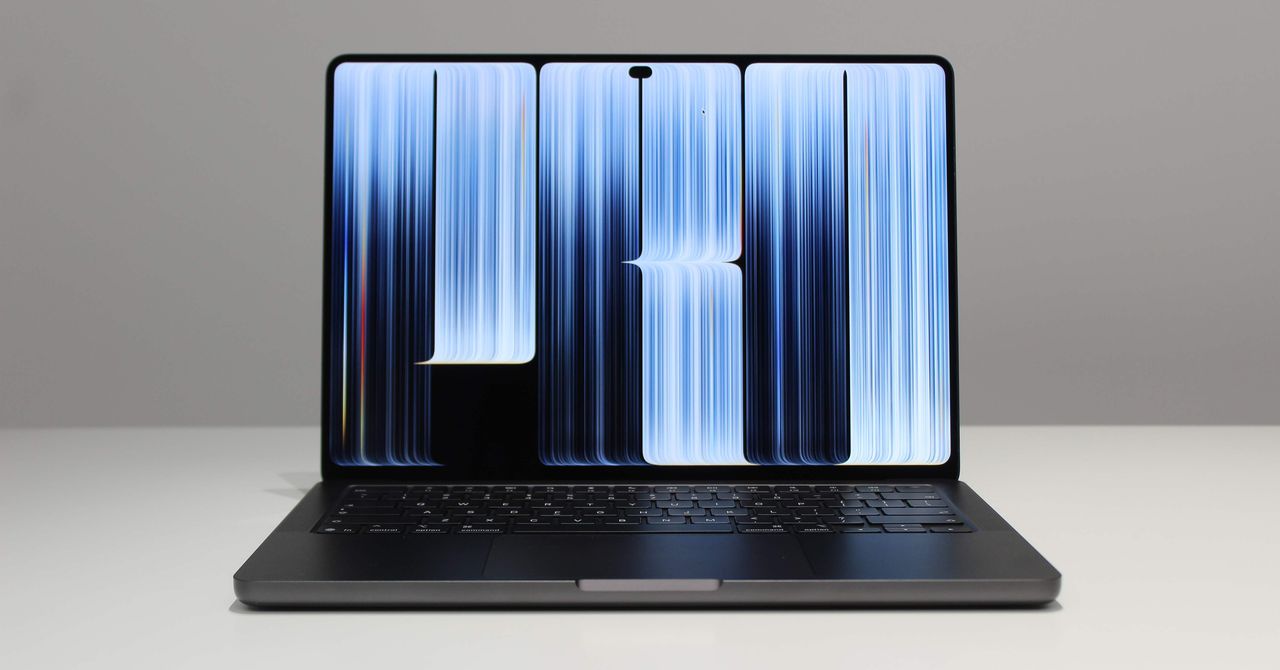
There are some subtler tweaks. The rubber feet on the bottom have softer, rounded edges. The bezels around the screen are slightly smaller.
Even Brighter OLED
It’s been over two years since Apple first brought its tandem OLED displays to the iPad Pro. In that time, MacBook Pro users have been patiently using the same Mini-LED display. Nevertheless, the OLED MacBook Pro has finally arrived, and Apple has pushed the tandem OLED panel further than ever before. This is the brightest laptop display I’ve ever tested, capable of reaching up to 1,000 nits in SDR. That’s on everyday content throughout the operating system and across all apps. The screen can, however, crank out 2,000 nits of brightness—but only in specific circumstances.

Photograph: Luke Larsen
For example, under very bright light or outdoors, the ambient light sensor built into the webcam module will detect those conditions and tune the display beyond the 1,000-nit upper limit. Combine that with the optional nano-texture screen, and you have what is undoubtedly the best laptop for working outside. That’s especially impressive considering glare is a big problem with typical OLED laptop screens. (You’ll need to turn on the “Automatically adjust brightness” setting, which I typically don’t.) Apple sent me the OLED with standard glass for testing, which comes with an anti-reflective coating that the company calls “ground-breaking.” Next to the non-OLED M6 MacBook Pro, it looks about as reflective. If you really want to use this thing outside, the nano-texture upgrade is well worth it.
HDR content is the second situation in which the screen can be cranked up to 2,000 nits of peak brightness. Here, the idea isn’t to blast your eyes with brightness; it’s about details. In HDR-rendered photos, videos, movies, and games, 2,000 nits would be bright enough to deliver incredible depth of detail and color. I’ve never seen HDR like this on a laptop, and you really have to experience it to truly get it. In my HDR testing, my OLED MacBook Pro never quite reached 2,000 nits, maxing out at 1,849 nits. But amazingly, it can even produce this in a 25 percent window, and 1,025 nits with every pixel lit up. The only place you’ll find brighter OLED is in the very latest OLED TVs.