
Circle stock gained on Thursday after Bernstein reiterated its Outperform rating and $140 target, arguing that the stablecoin issuer’s mixed second-quarter results challenged the bearish case against the company.
Summary
- Circle generated $701 million in Q2 revenue, up 7% but about 2% below estimates.
- Bernstein’s $140 target implies roughly 114% upside from CRCL’s latest price.
- USDC circulation reached $73.3 billion, up 19% year over year but down 5% quarterly.
- Circle expects the Arc public mainnet to launch Sept. 16 with 11 institutional validators.
Bernstein argues Circle’s results challenge bears
Bernstein analysts led by Gautam Chhugani described Circle’s second-quarter report as a “counter thesis to the bears,” according to a Thursday note to clients.
The brokerage retained its Outperform rating and $140 price target. The target is more than double Circle’s Thursday price of $65.29, although Bernstein had previously lowered it from $190 in late July.
Circle reported $701 million in total revenue and reserve income, a 7% increase from the same period last year. The figure missed consensus estimates by about 2%, contributing to the mixed assessment of the quarter.
Profitability was stronger. Adjusted EBITDA rose 8% year over year to $143 million, while basic earnings per share of $0.19 exceeded expectations. Net income from continuing operations reached $48 million, improving by $530 million from the previous year’s loss, which included expenses tied to Circle’s initial public offering.
Reserve income still generated roughly 95% of total revenue, leaving Circle exposed to changes in US interest rates. A lower federal funds rate would reduce the returns the company earns on assets backing USDC.
USDC growth supports the long-term thesis
USDC circulation ended the quarter at $73.3 billion. That represented 19% annual growth but a 5% decline from the $77 billion reported at the end of the first quarter.
Onchain transaction volume reached $14.8 trillion during the quarter, up 151% year over year, according to Circle’s earnings report. The figures suggest network activity grew faster than the amount of USDC in circulation.
Bernstein argued that concerns about stablecoin competition underestimate Circle’s distribution, liquidity, and regulatory advantages. The analysts expect USDC adoption to expand beyond cryptocurrency trading into payments, tokenized real-world assets, and institutional financial infrastructure.
Circle also received final approval from the US Office of the Comptroller of the Currency to establish Circle National Trust. The federal trust bank charter places part of the company’s infrastructure under direct US oversight and could eventually allow the entity to manage USDC reserves.
Arc could reduce Circle’s reliance on reserve income
Bernstein identified Circle’s Arc blockchain and payments partnerships as possible sources of revenue outside interest earned on USDC reserves.
Circle plans to launch Arc’s public mainnet on Sept. 16. BlackRock, DTCC, Galaxy, Global Payments, ICE, Mastercard, MoneyGram, SBI Group, Standard Chartered, Sumitomo Corporation, and Visa will serve as founding validators, according to Circle’s announcement.
Management raised its 2026 forecast for other revenue and its revenue-less-distribution-cost margin. The revised outlook includes the expected recognition of $180 million from an Arc token presale.
Bernstein said current forward estimates may not fully account for prospective Arc staking income, gas fees, transaction revenue, and partnership activity. Those sources could help diversify Circle’s business, but their contribution will depend on adoption after the mainnet launch.
Circle stock faces resistance near $70
CRCL rose 3.18% to $65.29 on Thursday after trading between $60.01 and $65.91. The stock moved above the midpoint of its daily Bollinger Bands at $63.84, indicating that short-term momentum had improved.
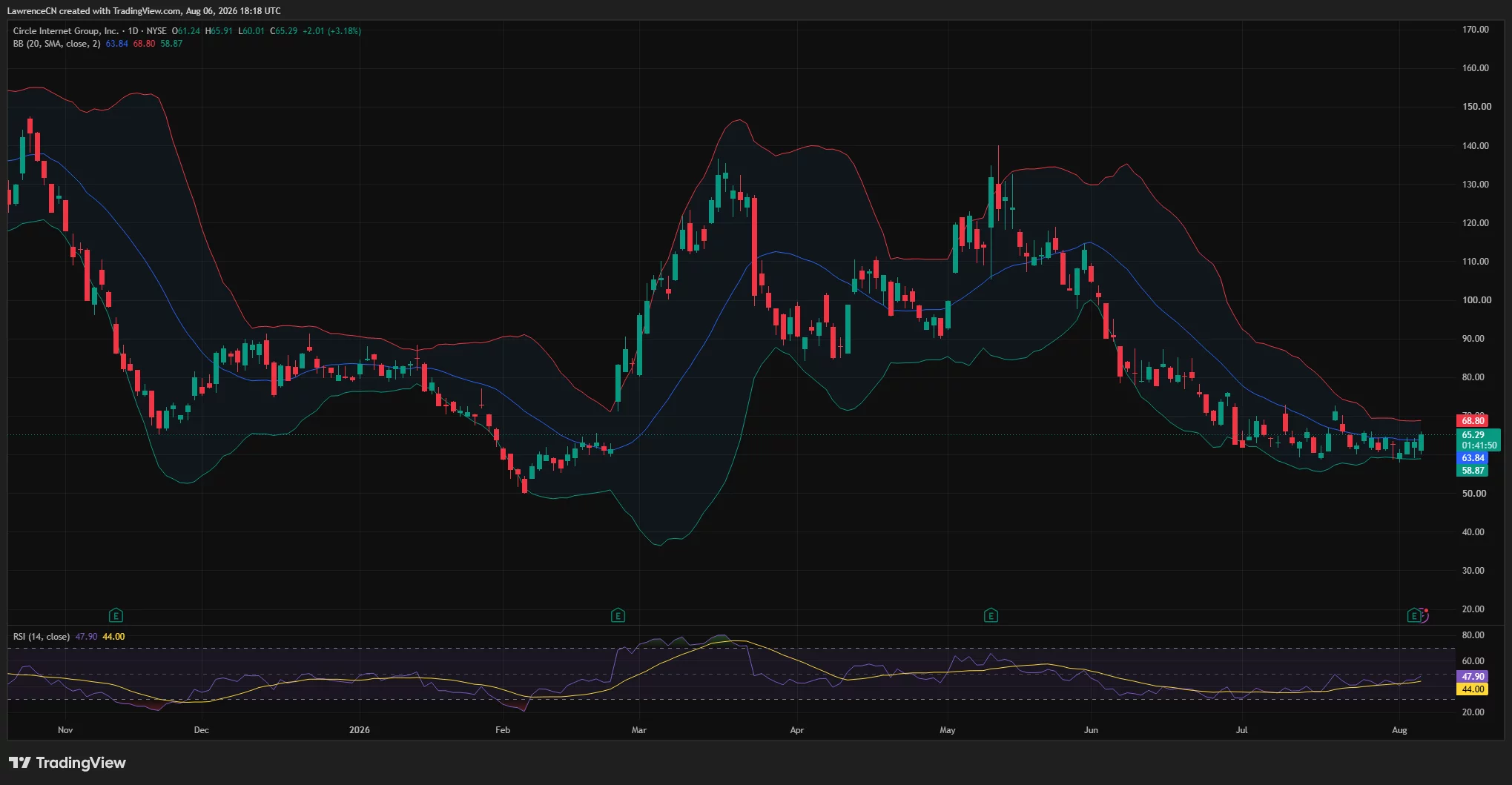
The relative strength index rose to 47.9, up from its moving average of 44. The reading remains below the neutral 50 level, meaning buyers have not yet established firm control.
Immediate resistance sits between $68.80 and $70. A daily close above that range could support a broader recovery, while failure to hold $60 would expose the lower Bollinger Band near $58.87.
Despite Thursday’s advance, Circle remains in a broader downtrend after falling from above $130 in May. Bernstein’s $140 target therefore depends on Circle restoring USDC growth, launching Arc successfully, and developing revenue sources less sensitive to US interest rates.