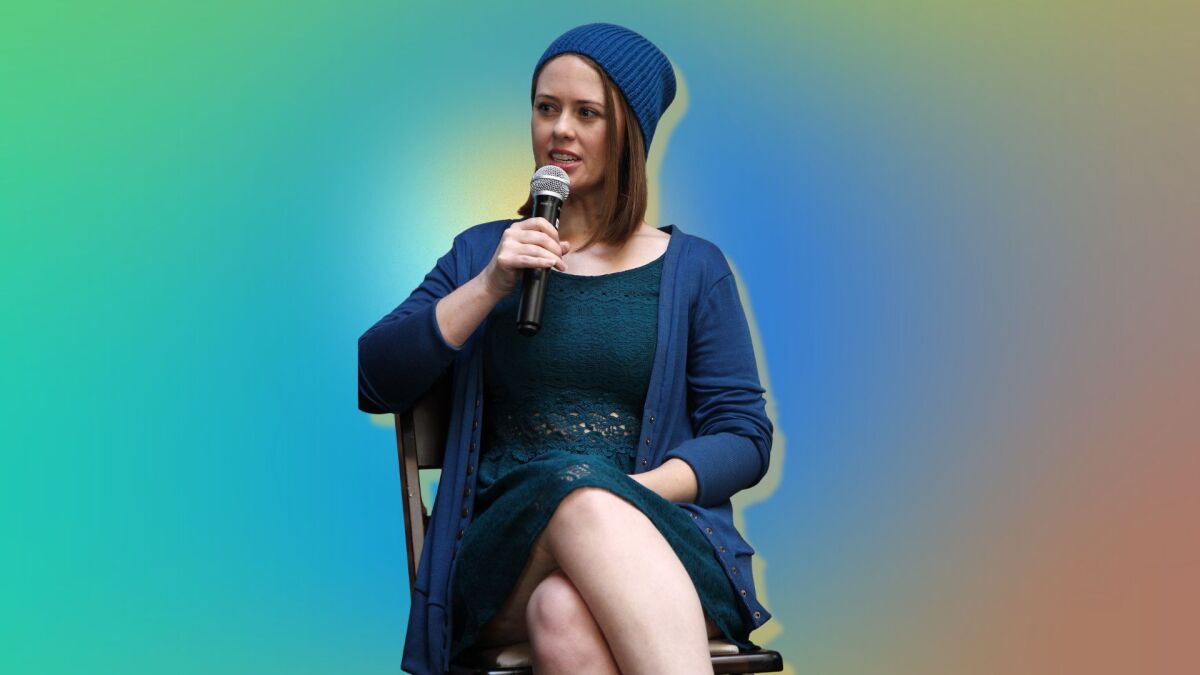
Jessica McCabe started posting on YouTube because she knew she couldn’t lose it.
McCabe lost notebooks and phones and was even capable of losing “her own head,” according to her mother. So whenever she wanted to revisit helpful articles, research, or her own notes on strategies for living with her ADHD, McCabe didn’t have an organizational system that made it easier for her to find (or actually remember) the information. Then, she realized one already existed.
“Anytime I wanted to show people this one really funny video on YouTube, I could find it. So I was like, YouTube. I won’t lose YouTube,” she told Mashable.
Thus, How to ADHD was born. Now, about 10 years later, the mental health creator has 1.94 million subscribers on YouTube, 100,000 followers on TikTok, a book she wrote called How to ADHD, and a second book in progress. The day before we spoke at VidCon, she gave two presentations at the World Confederation of Cognitive Behavioral Therapists Congress alongside experts, including doctors and research fellows, in the fields of psychology and psychiatry.
So yes, McCabe is a mental health creator, but she’s also a verifiable force in the global mental health community. Mashable sat down with her to learn how her channel transitioned from a place to catalog her findings for herself to a full-fledged business, how she stays organized as a neurodivergent creator and mother, how she can care for yourself while connecting with her audience, and her hopes for the online mental health content creation space.
Tell us about the research process that goes into your videos, both when you first started and how it has evolved over time.
The research process has definitely evolved. It started out as me Googling things, like, “I have ADD. What does that mean?” And I was like, oh, a lot of articles say it’s not called ADD anymore. It’s apparently all ADHD now. And oh, it doesn’t just impact focus. It impacts executive function, too. I didn’t know that. Over time, as I was posting this information on the channel, people in the comments would be like, “Do you know about Google Scholar? Do you know about PubMed?” Or eventually it was, “Hey, I’m an ADHD researcher. Would you like help? I see you’re trying to disseminate good scientific information about ADHD.”
So I started working with researchers. And even then, it took a little bit. The first researcher that I worked with was very pedantic and wanted to use very technical language. And I was like, I’m trying to disseminate to a lay public. I need to simplify a bit. I need to do that without losing important nuance, but I do need to be able to restate it in words that anybody can understand.
The current researcher I work with is Dr. Patrick LaCount. He’s now our chief science officer, and he reviews everything on our channel. So if you see that we have the little badge on our channel that says, “We’re on the Health Shelf“, it means it’s a channel from a trusted provider. That’s because Dr. Patrick LaCount reviews everything that I put out before I put it out.
That’s not a given on every mental health channel. It’s amazing that you guys have that.
It’s really important to me to ensure the information we’re putting out is accurate. Especially the fast pace that you have to go to as a content creator, where you’re posting every week or maybe sometimes more often than that. It’s really easy for things to slip through the cracks. So it’s really important to me to have that review process of, is this accurate? Because if it’s not accurate, then what am I doing?
Before you had researchers working with you, how did you handle that while maintaining a consistent posting schedule?
I did have a consistent posting schedule, and I am a recovering perfectionist, but I gave my perfectionism a different target. I was like, “OK, you can get as perfectionistic about this as you want. You can read as many articles to make sure that everybody’s agreeing with you and that you’re getting the right information as you want, as long as you can get that video out on Tuesday. And that was non-negotiable for me. For a while, I was able to do that, but then, as the amount of information I was trying to include grew, the scripts and videos got longer, and it became harder and harder to hit that mark.
So we’re still trying to figure it out. What that means for me now is that I’m not researching a brand-new topic every week like I did in the beginning. I’ve played around with different ways of doing it. One was like, “For this month, I’m learning about this topic, and all the content will be about it.” Now it’s a lot of, “Oh, I already know this stuff. I’ve already researched this stuff. I can make another video about the same topic.” But at first, I was killing myself because it was a new topic every single week, and I had to research from scratch.
That’s intense.
I don’t recommend it, but I did learn a lot. And now I have a book as a result.
So tell me a little bit more about the workflow you developed and how it came about.
So the workflow evolved quite a bit, too. When I first started, I was planning to do it by trial and error, like, OK, I struggle with organization or cleaning my house, so I’m going to try this strategy for a week. I’m going to film it and then edit it. Then I quickly realized that’s not actually doable in a week. You can’t figure out the strategy once a week, try it for a week, then edit it.
Instead, what I did was, OK, let me learn about this thing. I had a format that I used every single time: introduce the problem, explain the problem, introduce the solution, and explain the solution. I just did it on a blue wall and added graphics afterward. That worked really well. What didn’t work well was me trying to do it off the cuff because I learned really quickly I’m very hard to edit. I’ve gotten better. Hopefully, this is not terrible.
So, quickly, my process went from “let me try and speak off the cuff about what I’ve learned” to “that’s not going to work, that’s going to be impossible to edit” to “what if I outline?” But then I would look at the outline, and my mind would go blank because there would be all this pressure to like say whatever it was that I meant when I had that bullet point written down. So then I was like, I need to script. I just need to script.
Mashable Trend Report
The problem is that as an actor, I didn’t do very well, partly because I had such a hard time memorizing lines. So very early in the process, I had a giant whiteboard, and I printed out every single word in giant, like 36-point font, and I just taped it to this whiteboard. I used what was my strength, which was I got really good at cold reading, but really bad at memorizing lines. Anytime I went into an audition as an actor, I was like, “Let me cold-read.” So I’d glance down, glance up, and say the line, glance down, glance up, and say the line. So some of it was happy accidents. Like our punch-in, punch-out style was to cover the fact that I had to look down between the lines.
For the part of your workflow that involves other people, at what point did you decide you needed to build out your team, and how did you approach that process?
That evolved over many, many years. At first, it was my boyfriend at the time, like, “Hey, you’re an editor. Can you throw a couple of graphics on this?” Once I edited it, I was like, here you go, make it pretty, and he would take like a few hours to punch it up.
Over time, it became clear that what I was doing was really meaningful to people and could turn into something, right? More than just a personal project. So he did more and more until I was like, OK, I’ve got to pay this guy. I actually ended up hiring him full-time before I was full-time.
I was still waiting tables, but I was like, I need an editor. I will work for free 24/7. He will not, understandably. Eventually, I was able to go full-time as well. Then, when that marriage fell apart, I had to hire a team. There were a couple of people that I actually met at VidCon who were like, “Oh yeah, we can do some editing for you, and we can do some animations.”
Digital organization was such a big struggle for me as someone with ADHD that I ended up hiring somebody literally to organize my shit. Our community manager had been volunteering on our Discord for a long time, and finally, after a couple of years, I was like, “We should hire you, though.” Basically, my whole strategy was that whenever I wanted to hire a new person, I brought one on. Now I have a pretty robust team.
What’s having a team like? Because content creation and running a team are very different skill sets.
It is a very different skill set. Also, moving from “I’m going to have people I know help me with this thing” to “oh, I am hiring for a position, and I need to vet that person” was interesting.
An ADHD creator friend of mine, Dani Donovan, recommended a recruiter that she had worked with because she was also in the same boat of hiring friends. So for the first time, we used a recruiter who found us our current producer, and I was like, this person is amazing.
If I could go back in time, I’d work with a recruiter. It’s really important as a creator to work with people. I made the mistake early on of prioritizing the hard skills. How good are you at animating? How good are you at editing? How good are you at these skills? And I didn’t prioritize the soft skills — how are you collaborating with the rest of the team? Are you an easy person to work with? Can you take feedback? Now I really prioritize soft skills.
I would love to talk about your relationship with your audience. I imagine it has grown, but I feel like, especially being a mental health creator, there’s an extra weight to that, and people come a lot with their personal experiences. So how do you navigate that?
It’s tough because I started out as a peer in my community. I was somebody who was learning about my ADHD for the first time; they were learning about theirs. We kind of came up together, and that was a really cool experience.
It also meant that if someone was struggling, it was almost like I was struggling too. We were in the same boat. And my boat was starting to float, and I didn’t want to let their’s to sink. I wanted to respond to every comment. I wanted to help everybody. As the channel grew, I couldn’t anymore. I would get to the point where I would be overwhelmed with taking on a lot of people’s pain and needs. I would need to step away for a little bit, but then I would come back, and there would be so many messages.
Facebook was really the first place where this was overwhelming for me, all of the direct messages that you would get. One day, I went to respond to a message, and by the time I got through like five messages, that person had already responded, so I was in a conversation with them. And I went — it’s not just that I’m procrastinating or avoiding or like not doing the right thing by not responding. I can no longer respond to people.
So that’s when I had to evolve it to let me read the comments and hear what people are saying. Then I need to make content that speaks to that struggle, content that will be for more than just that one person. That was a tough evolution for me in moving away from that one-to-one relationship.
I imagine there could have been some guilt there. Like, you’re letting a version of a relationship go.
It was painful moving into this parasocial space where I don’t know everybody in my community anymore. We don’t have regular conversations, but I still very much care and want to be there for people. I just can’t in the same way. So one of the things we’re doing now that I’m really excited about is that I’m going to start coaching people one-on-one.
I can get the one-on-one I really value, but then we put that content online so other people can benefit, too.
Since becoming a mom, do you feel that the way you approach the content itself, or the way you approach the work of creating the content, has changed?
It has changed. The first change is obviously having to take a break. As a content creator, you’re producing content week after week after week, maybe day after day after day. But maternity leave is a thing that is apparently important! So I had to figure out how to keep putting out content while I’m away and set my team up for success to do that.
Even then, it was really rough that first year to create content, because it felt like my brain had been hijacked by this new passion, this new child. My brain had literally been rewired. It also coincided with finishing my book and putting that out into the world. I finished my project of learning everything I could about my ADHD brain, putting it somewhere I could find it again, and making it available to other people, and I was embarking on a new one: motherhood.
And suddenly, my entire hyperfocus was on being a mom, and I did not have a channel for it. I don’t want a channel about being a mom. So most of what I was learning no longer made sense to share with my community. That was a big, big shift for me because I had to figure out how to keep making content for this community when that’s not where my head is at. So we changed up how we were doing content. I was no longer just a talking head on a blue wall. We also hired the wonderful new producer I was telling you about, and he’s local, so we were able to start filming skits in my house and doing wild projects like having Cas from Clutterbug come down and help me reorganize my entire house. We were able to do different kinds of content.
But it was very much an exploration of what kinds of content my brain can focus on. What kind of content do I want to make?
What are your hopes for the mental health content creation space going forward? And as a second part, who are the creators in that space now that you think more people should be watching?
Therapy in a Nutshell is great. Dr. Tracey Marks is great. Also, Daniel from The Aspie World. He’s great for anybody who’s dealing with autism. A lot of people who watch my channel are like, can you do this, but for autism? And I’m like, I don’t have autism. But my friend does!
There are a lot of great mental health creators. But what I’m hoping for in this space is that we get more people with lived experience connecting with people who have research-backed, evidence-based information, and then we disseminate that. There are many academic researchers speaking to it, and many speaking from personal experience. But I would love to see more people doing what I’m doing, which is speaking about their personal experience as a vehicle to share evidence-based information, so it’s not just, “This one thing worked for me.” It’s, “This is what works for a lot of people, and it worked for me. Maybe it would work for you, too.”