
Key Takeaways
- Saylor calls digital ownership bitcoin’s most profound breakthrough.
- Private keys authorize control but do not register legal identity.
- Strategy has reported no bitcoin purchase since June 22.
Saylor Defines Bitcoin’s Core Breakthrough
Bitcoin can place economic value under digital control across individuals, institutions, automated systems, and governments, according to Strategy Inc. (Nasdaq: MSTR) Executive Chairman Michael Saylor. In an Aug. 23 post on X, Saylor stated:
“Bitcoin’s most profound breakthrough is the ability to convert economic energy into digital form and bind it securely to a person, family, company, machine, or nation.”
The statement extends Saylor’s long-running effort to frame bitcoin as monetary technology rather than simply a tradable cryptocurrency. His earlier framing of bitcoin as digital monetary energy connected value preservation with proof of work, fixed supply, digital transferability, and owner-controlled keys. The latest post compresses that broader thesis into a single claimed breakthrough.
An institutional assessment provides a separate comparison point for several characteristics underlying Saylor’s claim about bitcoin. Fidelity Digital Assets’ assessment of bitcoin examines scarcity, decentralization, censorship resistance, and proof of work while warning that digital assets remain speculative, volatile, and capable of losing their entire value. That analysis does not endorse Saylor’s energy metaphor.
How Bitcoin Binds Value to an Owner
Bitcoin does not technically attach coins to a legal identity, family, corporation, machine, or country. The network’s original design instead defines an electronic coin as a chain of digital signatures, with transactions transferring control under cryptographic rules rather than recording a named owner. Saylor’s “bind” language therefore describes controllable digital property, not identity registration.
Control depends on possession and protection of the cryptographic credentials required to authorize each transaction. A Bitcoin wallet uses private keys to create digital signatures, allowing the network to verify spending authority without receiving the secret key itself. Custody arrangements can assign authority to an individual, family, company, or government entity, while software can automate a machine’s use of cryptographic keys.
Public ledgers also create visibility that qualifies any simple description of ownership as permanently private or untraceable. The Treasury Department found that blockchain analytics can trace transactions, attribute addresses, flag suspicious patterns, and assess counterparties. It also noted that such tools depend on probabilistic methods, face coverage gaps, and can lose confidence across services or blockchains.
Strategy Trims Its Reserve as Banks Court Digital Assets
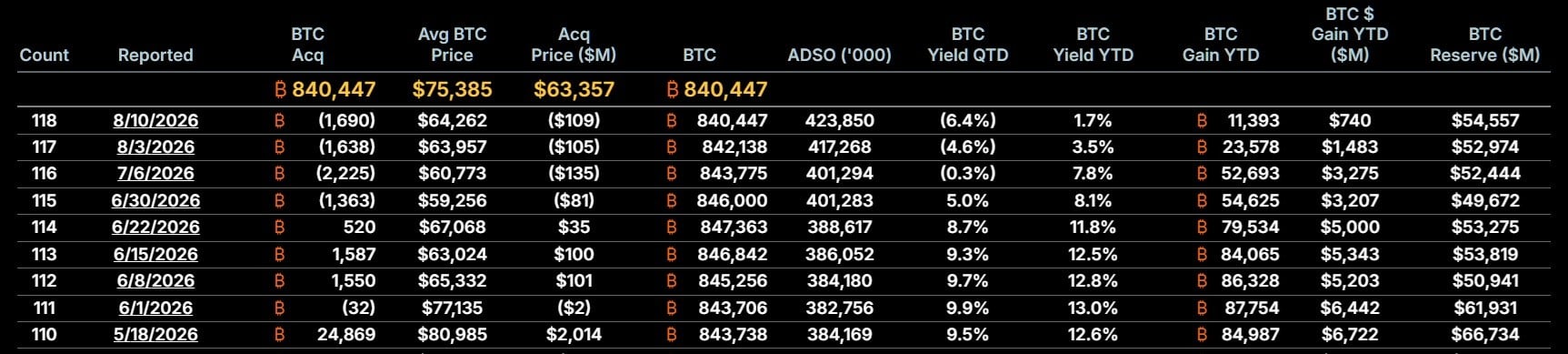
Strategy provides Saylor’s most prominent corporate example of holding a large bitcoin reserve. The company’s Aug. 17 Form 8-K showed 840,447 BTC as of Aug. 16, acquired for $63.36 billion at an average $75,385 per bitcoin, including fees and expenses. Its own ledger records no purchase since June 22 and four sales totaling 6,916 BTC across the eight weeks that followed.
Saylor has also argued that bitcoin can support financial products designed for different owners and risk preferences. His four-part digital money stack places BTC at the capital layer, Strategy’s STRC preferred stock at the credit layer, a yield-bearing token at the money layer, and USDT at the currency layer. Those instruments introduce issuer and counterparty risks beyond bitcoin’s price and custody risks, while liquidity conditions can affect both.
Government attention now extends beyond individual ownership as bank applicants propose incorporating digital assets into business models. Comptroller of the Currency Jonathan Gould stated Aug. 19 that 23 of the 40 bank-charter applications received during the previous 18 months involved some form of digital-asset activity. He said integrating payment stablecoins was becoming an ordinary component of potential applicants’ plans.