Key Takeaways
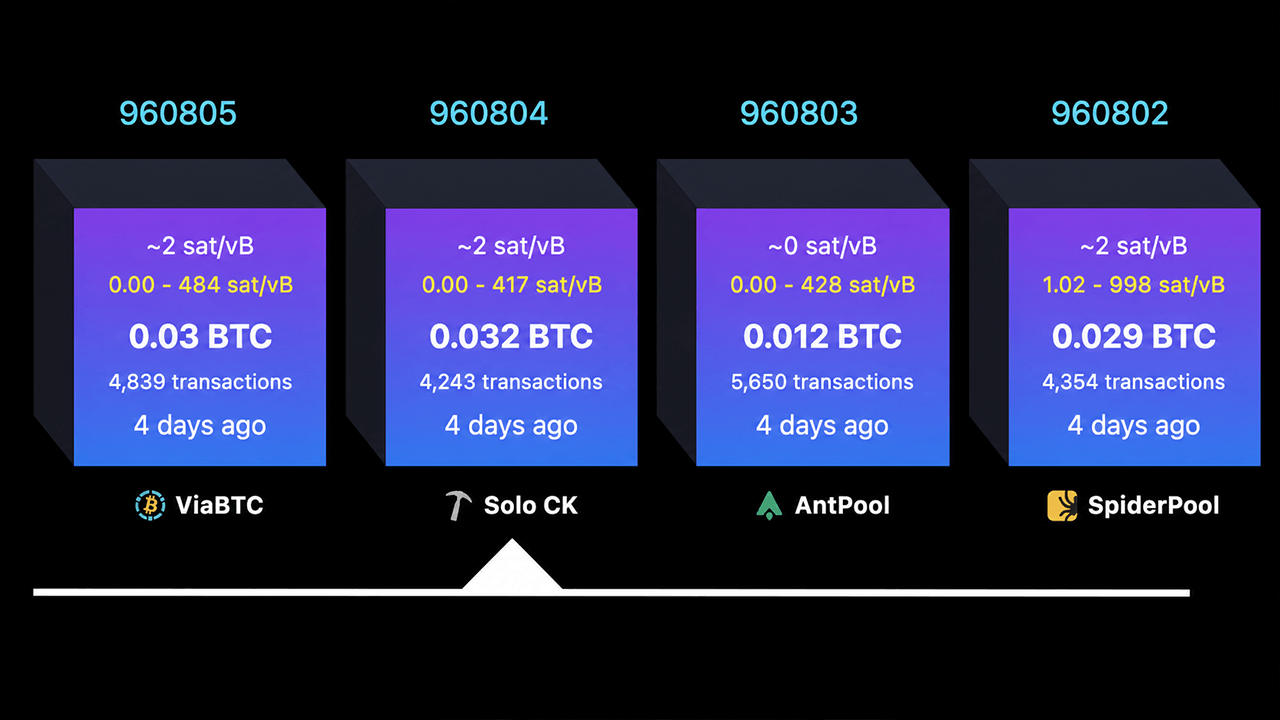
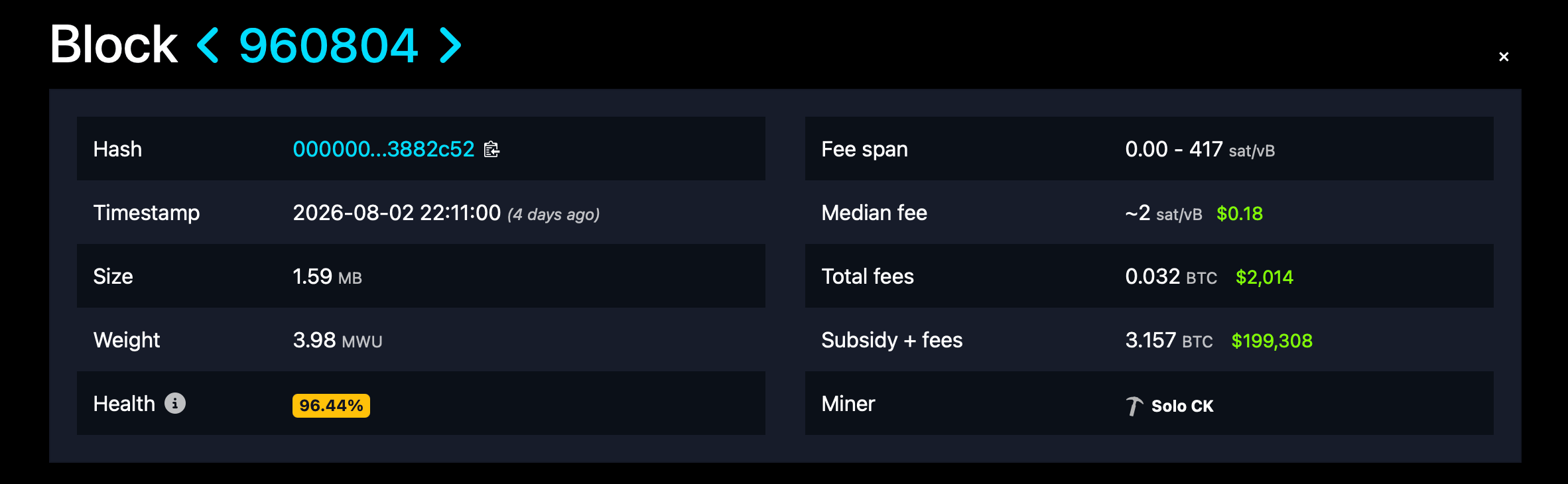
- A solo miner using CKPool claimed block 960804’s 3.1569 BTC reward on Aug. 2, 2026.
- The win marked CKPool’s 317th solo block, according to developer Con Kolivas.
- Bitcoin’s next difficulty adjustment is expected in mid-August 2026 after recent hashrate shifts.
The payout went to a bitcoin address tied to CKPool, a solo mining service that lets people point their equipment at shared infrastructure without running their own Bitcoin node. It was the 317th solo block CKPool has found, according to the pool operator’s X thread.
What Made This Block Different
The reward combined the fixed 3.125 BTC subsidy with about 0.032 BTC in transaction fees pulled from 4,243 transactions packed into the block. Bitcoin blockchain explorers, including mempool.space, Blockchain.com and Blockchair.com, all confirmed the payout and attributed it to Solo CKPool.
CKPool developer Dr -ck, whose real name is Con Kolivas, confirmed the win on X. He described the miner’s computing power as “wildly variable, presumably rental, peaking at 100 PH.” PH stands for petahash per second, a measure of how many calculations a mining rig can perform each second while trying to solve a block.
That peak represented about 0.011% of Bitcoin’s total network hashrate, which sat near 924 exahashes per second at the time. An exahash is a quintillion hashes per second, or a million petahashes. At that level of computing power, a miner could expect to find a block roughly once every 64 days if the hashrate held steady. That is a far shorter wait than the decades a small home setup would typically face.
Why Solo Mining Still Works
Solo mining differs from joining a traditional mining pool. In a pool, miners split the reward based on how much computing work each person contributed, whether or not the pool actually finds a block. Solo mining pays nothing until the miner personally solves a block, and then pays everything.
CKPool takes a small cut, commonly cited around 2%, of any block its solo users find. The service has now facilitated 317 such wins.
Dr -ck said the miner’s hashrate pattern pointed away from a fixed home setup and toward rented computing power, a practice that lets people temporarily access far more hashrate than they own. Rental markets have made solo wins like this one more reachable than pure hobbyist odds would suggest, though success remains far from guaranteed on any given day.
The Developer’s Own Words
Dr -ck framed the moment against a rough week in the crypto industry. “Despite the chaos from the hardware wallet exploit, bitcoin just keeps on doing its tick-tock next block,” he wrote, referring to reports of the now infamous Coldcard hardware wallet exploit with losses estimated in the nine figures.
The developer also noted a technical milestone tied to the win. “This is the first mainnet block solved since the incorporation of the Stratum V2 code into the ckpool codebase,” Dr -ck wrote in the X thread, adding that the block was actually found using the older Stratum V1 protocol. Stratum is the communication method mining hardware uses to talk to a pool.
Dr -ck pointed to how deterministic the timing looked in hindsight. “This block was solved on the same main pool that has solved most of the blocks, purely as a function of its hashrate,” he wrote. “AU, SG, and US East are yet to solve blocks.” He added that the find was “virtually deterministic at almost exactly 100% diff,” referring to the pool’s mining difficulty setting at the moment the block was found.
Why It Matters for Bitcoin’s Bigger Picture
Bitcoin mining has consolidated around a handful of large industrial pools, including Foundry USA, Antpool, ViaBTC and F2pool. Solo finds remain rare against that backdrop, but they keep happening. Each one shows that anyone with enough hashrate and a valid block template can still claim a full reward, without needing permission from a company or government.
The 3.125 BTC subsidy stays fixed until Bitcoin’s next halving, expected near block 1,050,000 around spring 2028, when it drops to 1.5625 BTC. Fees will carry more weight in mining rewards over time as that subsidy keeps shrinking.
What to Watch Next
Bitcoin’s next difficulty adjustment is projected to occur this weekend on Aug. 8, which will reset how hard the network is to mine based on recent hashrate. Interestingly, the BIP-110 soft fork mandate is expected to occur at around that same time. Network hashrate itself has shown some pullback from late-2025 peaks, a shift analysts tie partly to mining economics and competition for electricity and hardware from artificial intelligence (AI) data centers.
The identity of the miner behind block 960804 remains unknown, as is typical for bitcoin addresses. Whether this person continues renting hashrate, scales up, or simply cashes out is not public information.
Hero/Feature image source: Mempool.space